November 2026
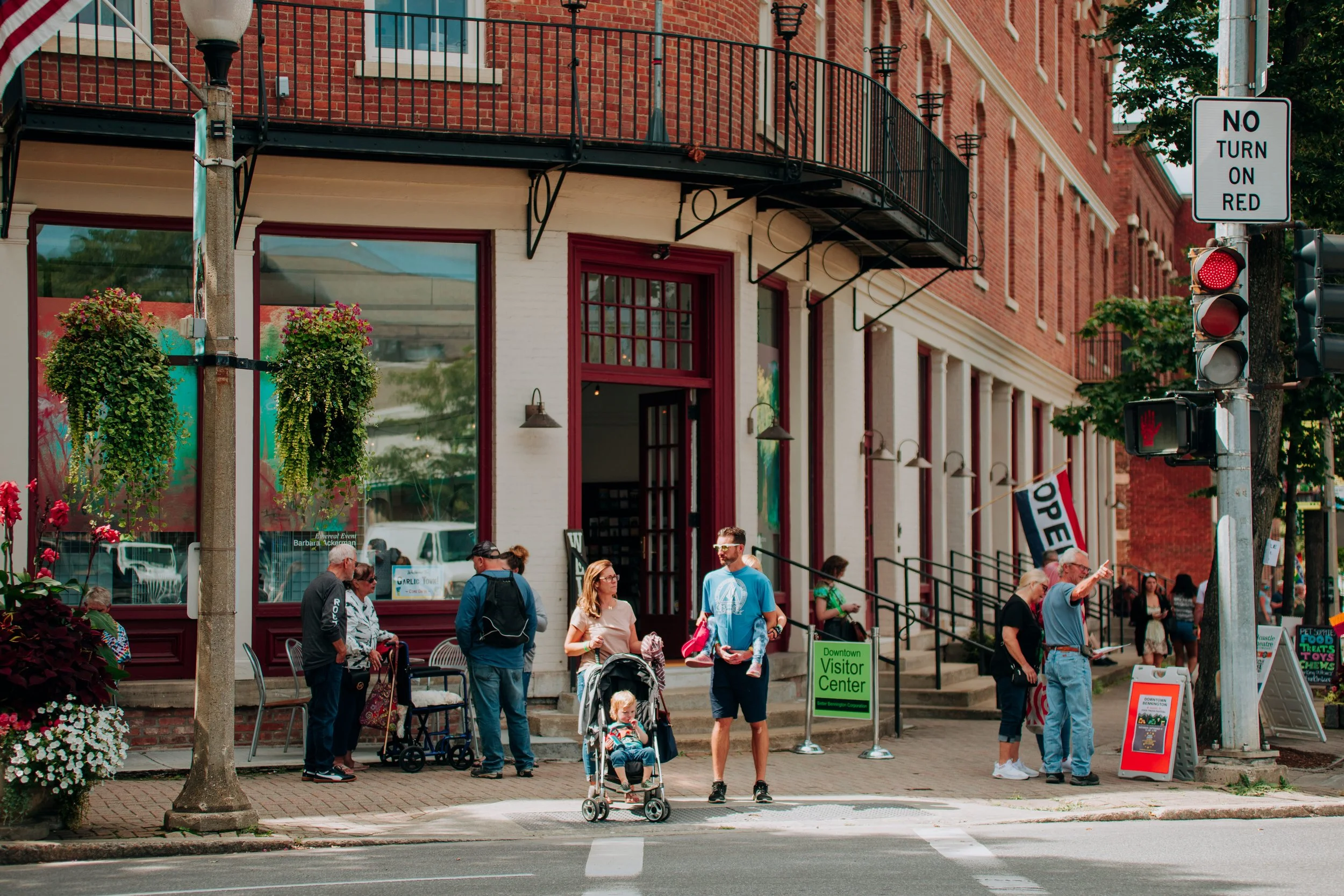
With the recent announcement that Jim Brown will retire as President and CEO of The Bank of Bennington next spring, following Tom Dee's retirement from Southwestern Vermont Medical Center earlier this year, I found myself reflecting on a remarkable generation of community leaders who helped change the trajectory of Bennington.
Jim and Tom were part of a visionary group that came together nearly a decade ago to do something extraordinary: take a collection of deteriorating buildings in the heart of downtown Bennington and transform them into the Putnam Block redevelopment. Alongside leaders like Mariko Silver of Bennington College, Dr. David Evans of Southern Vermont College, former Select Board Chair Tom Jacobs, and several civic-minded investors and business leaders, they did more than rehabilitate a few buildings. They helped restore a sense of possibility to a community that desperately needed it.
Today, many of those original leaders have moved on from their positions. Others remain involved, but their roles have changed. And beyond that initial group, we've experienced a broader changing of the guard across Bennington. We've lost the late Stu Hurd, our longtime town manager; Senator Dick Sears, who represented Bennington County for more than three decades; and former Representative Anne Mook. We've seen transitions in leadership at major institutions, including United Counseling Service and the Better Bennington Corporation.
For someone who has spent much of his professional life working alongside these individuals, these moments feel a bit like the changing of a season. Or, yet another cast change on Grey's Anatomy! Some were friends. Many were mentors and colleagues I deeply respected. Nearly all helped shape my understanding of what it means to lead a community.
What made so many of these individuals extraordinary wasn't simply their titles or their accomplishments. It was something I've written and spoken about for years: catalytic leadership.
In chemistry, a catalyst is something that accelerates a reaction. In communities, catalytic leaders accelerate progress. They take ideas that have been discussed for years, align people and resources around them, and create enough confidence for something meaningful to happen. But here's what makes their leadership truly catalytic: their actions inspire other people to act. One investment encourages another. One bold project makes the next seem possible. One leader's willingness to take a risk gives someone else permission to do the same.
Think about what the Putnam Block represented ten years ago. It would have been easy for those institutional leaders to remain within the comfortable boundaries of their own organizations. A hospital runs a hospital. A bank makes loans. Colleges educate students. Town government manages municipal services. Yet these leaders understood that their institutions' futures were tied directly to Bennington's future. They put their money, influence, and reputations behind a larger vision.
And look what followed.
I now believe we are approaching halftime in Bennington's transformation. The first half began roughly a decade ago, when a collection of leaders decided that decline was not an acceptable long-term strategy. That shift in thinking helped lay the groundwork for what we see today: the transformation of Benn High, the continued evolution of the Putnam Block, renewed activity at the former Southern Vermont College campus through The Orchards, and redevelopment opportunities at the Bradford/Lauzon Mill, the former Energizer property, the Spring Center, and other long-underutilized buildings.
Add to that the restoration efforts at the Walloomsac Inn, new public spaces and recreational investments, broadband expansion, and a growing collection of entrepreneurs bringing life back to storefronts and commercial corridors. These projects are at different stages of planning, financing, and construction, and not every proposal will unfold exactly as envisioned. But collectively, they tell a very different story about Bennington than the one we were telling ten years ago.
None of this happened because one person had a good idea. It happened because leadership created the conditions for other people to invest, build, collaborate, and dream a little bigger.
Had I written this column a year or two ago, I would admit that I was worried. As these larger-than-life community leaders began retiring or passing away, I wondered whether we had enough people ready to carry their work forward. Would our institutions retreat into their own priorities? Would we lose the willingness to take big risks? Would the momentum slow?
Today, I feel differently.
I watch Dan Monks establish his own direction as Bennington's town manager, building on decades of institutional knowledge while helping shape a new chapter for town government. I watch Dr. Estevan Garcia take the reins at Southwestern Vermont Medical Center with an energy and ambition that suggest no intention of slowing down. I also see Dr. Danielle Egan, the new president of Bennington College, already embracing a broader civic role, recently partnering with the UVM to host the inaugural Vermont Listens discussion — bringing neighbors with different perspectives together to listen, build trust, and strengthen the connections that move communities forward.
I see a new generation of developers, business owners, nonprofit executives, municipal leaders, philanthropists, and civic volunteers taking on challenges that would have seemed nearly impossible just a few years ago.
And I am reminded of another remarkable quality of catalytic leaders: the best ones don't just accomplish great things. They inspire and attract other people capable of accomplishing great things after them.
The first generation did not hand us a finished community. They handed us something far more valuable: a foundation, a collection of tools and resources, a renewed sense of confidence, and perhaps most importantly, permission to dream a little bigger for Bennington.
Now we need to take the ball and carry it through the second half.
So, to Jim Brown, thank you for more than 25 years of service to The Bank of Bennington, for your mentorship, your investment in our community, and your willingness to step forward when Bennington needed bold leadership.
And to those stepping forward today - whether you're leading a major institution, opening a small business, serving on a local board, developing housing, or simply refusing to accept that things cannot get better - thank you. Our community needs you, perhaps now more than ever.
We've had a remarkable first half together. Now it's time to see what Bennington can become in the second.
Always Onward,
Matt Harrington
CEO, Southwestern Vermont Chamber Foundation